Power Wheelbarrow for Steep Slopes: How to Choose the Right One
NEWS · 24 April 2026
Working on sloping terrain is never easy. Whether you are dealing with hillside vineyards, terraced orchards or agricultural sites that are difficult to access, having the right equipment can make all the difference.
In this context, choosing a power barrow for steep slopes is not just a matter of convenience, but also of safety, efficiency and productivity. In this guide, we will look at how to choose the most suitable model, which features to evaluate and which mistakes to avoid.
Why You Need a Power Wheelarrow for Steep Slopes
When working on sloping ground, a standard power barrow can become unstable and dangerous. The risk of overturning increases, especially with heavy loads or on uneven terrain.
A power barrow designed for steep slopes, on the other hand, offers:
- greater stability;
- better traction;
- increased operator safety;
- the ability to work even in difficult conditions.
This is particularly important for:
- winegrowers working on hilly terrain;
- farms in mountainous areas;
- forestry operators;
- material-handling work on sloping construction sites.
If you work in this type of environment, it is worth choosing professional power wheelbarrows such as those manufactured by Zanon. Let’s now look at the various features to consider so you can make an informed choice.
Tracked or Wheeled Power Barrow: Which Should You Choose for Steep Terrain?
One of the first decisions to make when buying a power barrow concerns the traction system. It is not simply a technical issue: choosing between tracks and wheels directly affects stability, safety and the ability to work on difficult terrain. Understanding the differences between these two solutions helps you avoid mistakes and invest in a machine that is genuinely suited to your needs, especially if you operate on steep slopes.
Tracked Power Barrow: The King of Steep Slopes
Tracked power barrows are the best choice for difficult terrain.
Advantages:
- better grip on the ground;
- even weight distribution: the track spreads the load over a larger surface area, increasing traction;
- stability on mud, gravel and steep slopes;
- reduced risk of slipping.
Wheeled Power Barrow: When Should You Choose One?
Wheeled power barrows, on the other hand, are suitable for flat or slightly sloping terrain.
Limitations:
- less stability;
- difficulty on uneven terrain;
- greater risk of losing control.
For significant slopes, tracked power barrows are by far the best choice.
Essential Technical Features for a Power Barrow Designed for Slopes
Choosing a power barrow is not simply about looking at the price. There are several fundamental technical aspects to consider when making your purchase.
1. Maximum Supported Slope
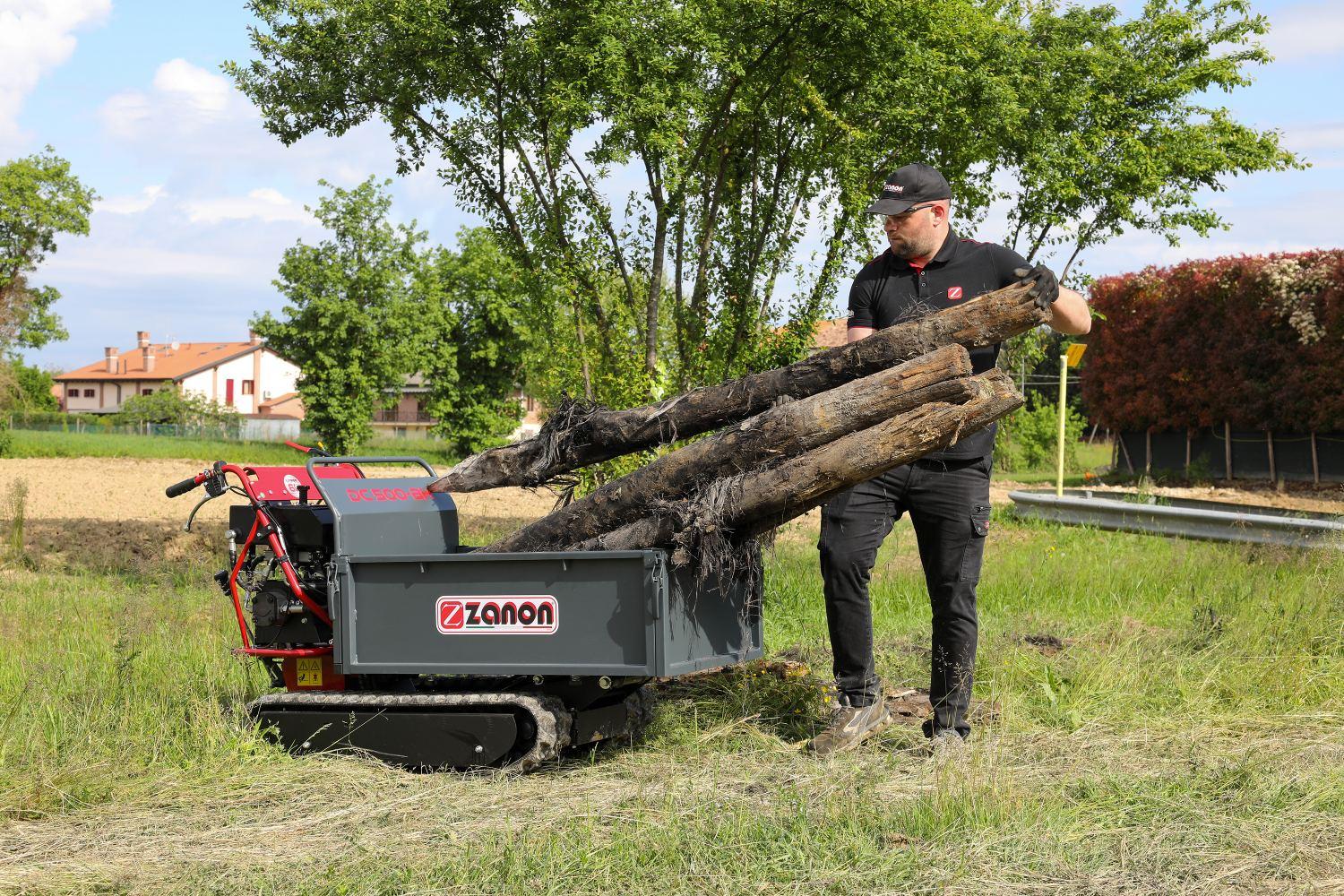
Every model has a maximum inclination limit. For hillside work, choose models specifically designed for steep slopes. Models such as the DC 500 B tracked power barrow with tipping skip and the DC 500 BH tracked power barrow with hydraulic tipping offer excellent performance even in difficult conditions.
2. Payload Capacity and Load Management
Consider how much material you need to transport:
- Light/semi-professional use: models with a capacity of 300–400 kg, such as the compact DC 300 B power barrow, ideal for narrow spaces such as vineyard rows.
- Professional use: machines with a capacity of 500–800 kg for those who need to move large quantities of firewood, grapes or construction materials.
3. Engine and Forced Lubrication
For steep slopes, the engine must have an efficient lubrication system to prevent seizure when the machine is tilted. A good engine ensures power and consistent performance:
- Petrol engines remain the most common choice in agriculture because they provide good autonomy and consistent performance even under heavy loads.
- Electric motors can be particularly interesting in enclosed environments such as greenhouses or in areas where noise is a limiting factor, offering immediate torque that is ideal for restarting on uphill sections where quiet operation and lower emissions are required.
4. Hydrostatic Transmission and Low Gears
The transmission should not be overlooked either.
- Hydrostatic transmission: allows better control of the machine, particularly uphill or downhill, where precise handling is essential.
- Low gears: are essential when descending, as engine braking must be able to manage the weight without overheating the mechanical brakes.
5. Stability and Low Centre of Gravity
Don't just look at "how much it can carry". Look at "where" the load is carried. A quality power barrow should have the skip positioned as low as possible. On a slope, a high load moves the gravity vector outside the support base, causing instability. A low centre of gravity improves safety on slopes and reduces the risk of overturning.
6. Tipping System: Manual vs Hydraulic
Finally, consider the tipping system. If you use the power barrow intensively, hydraulic tipping can save you time and effort. It allows you to unload hundreds of kilograms of material without physical effort and with a level of precision that a manual system cannot guarantee.
7. Emergency Braking System
Make sure the power barrow has an automatic locking system. When the controls are released, the power barrow must stop immediately, even when fully loaded on slopes of up to 30%.
Weight distribution also plays a key role. When loading your power barrow, try to position the heaviest material towards the front if you are going uphill: this will help the tracks maintain optimum grip at the front, preventing the machine from "rearing up".
In short, choosing the right power barrow means assessing all these factors and finding the right balance between performance, safety and actual use conditions.
Today we often hear about min-till, or minimum tillage. This concept is based on reducing the mechanical impact on the soil in order to prevent erosion and soil compaction while preserving soil biodiversity.
Using a professional tracked power barrow fits perfectly into this philosophy. Thanks to its low ground pressure, you can transport heavy materials without creating deep ruts that, when it rains, could become drainage channels and contribute to water and soil erosion. It is a sustainable choice that helps protect the value of your land over time.
Conclusion: Which Power Barrow Should You Choose?
There is no single "best power barrow"; there is the right one for your specific terrain. If your slopes exceed 20%, it is definitely worth investing in a tracked model with a professional engine and an extendable skip or hydraulically tipping skip to make unloading easier.
Remember: investing in high-quality agricultural mechanisation is not just about reducing physical effort. It also means increasing workplace safety and business productivity.
Want to see Zanon power barrows in action? Find the nearest dealer and request a live demonstration